

Architecture of Governance™
Governance isn’t compliance — it’s structure.
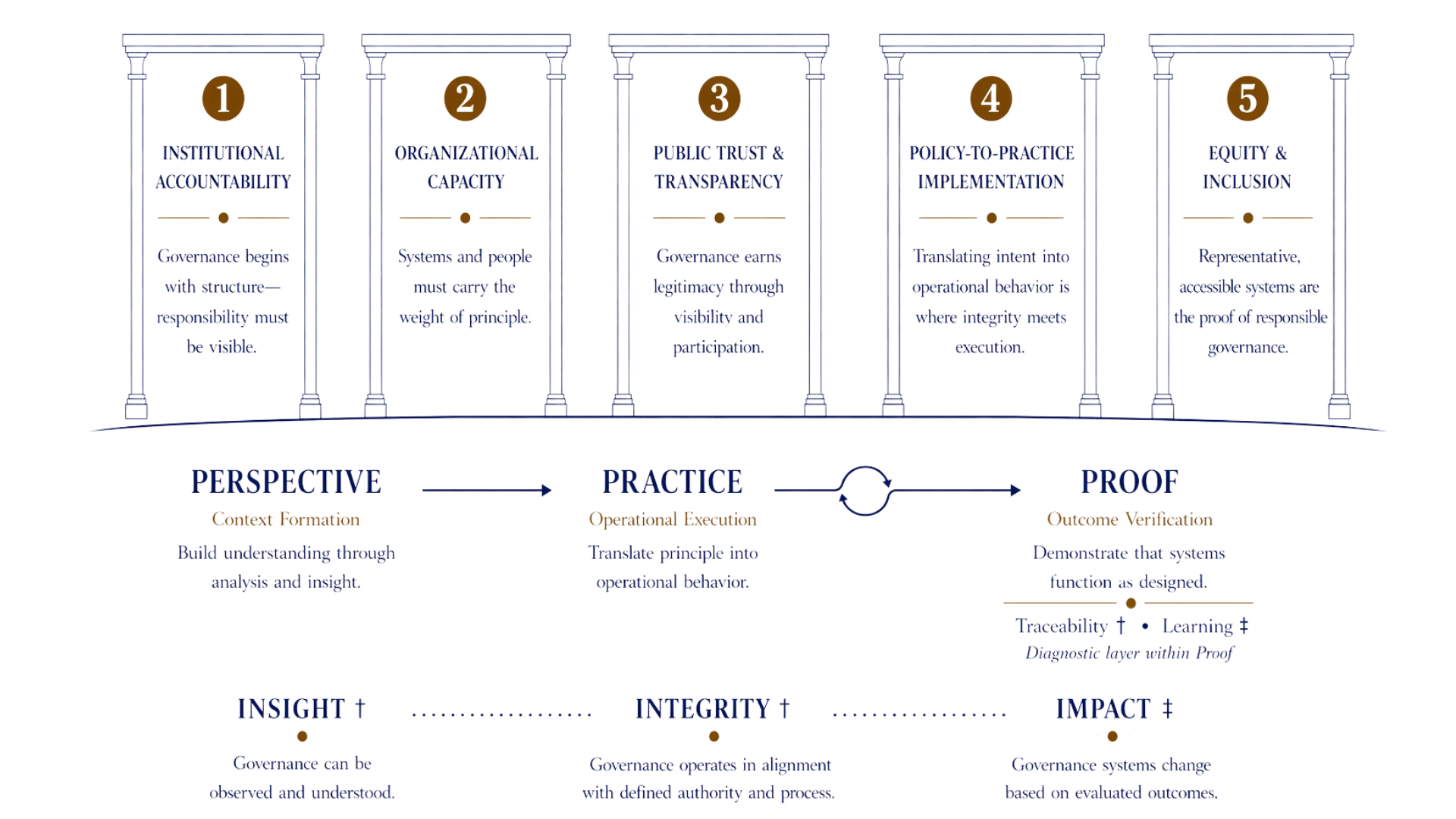
A design model that translates principle into performance—embedding clarity, capability, and measurable trust into institutional systems.
2025 TL Advisory. All rights reserved. The Architecture of Governance™ is a proprietary framework developed by TL Advisory to advance responsible innovation and institutional accountability. Reproduction, adaptation, or distribution without prior written permission is prohibited.
Governance is design, not bureaucracy.
It is the structure that turns intent into method and principle into performance.
These five pillars are not themes but architectural necessities—conditions that allow governance to evolve, endure, and sustain trust at the speed of change.
When visible and verifiable, these structures convert values into outcomes and oversight into infrastructure.
-
Governance begins with clarity—institutions must name, assign, and evidence responsibility.
Accountability makes oversight visible and converts ethical intention into verifiable action.
-
Design only matters when institutions can carry it.
Capacity links structure, skill, and process to create systems that adapt under pressure and sustain responsible innovation.
-
Trust is the currency of governance.
Transparency turns compliance into confidence by making decisions and data accessible, allowing credibility to be observed rather than assumed.
-
Governance fails where policy stops.
Implementation bridges purpose, people, and process so that principles operate as methods—embedding evaluation, feedback, and accountability into daily function.
-
Equity is not supplemental; it is the proof of competence in a plural society.
Inclusive governance distributes responsibility, embeds diverse perspectives in decision design, and ensures systems remain accessible across difference.
It is both an ethical standard and a performance measure—the condition through which governance demonstrates maturity and credibility.